- Product Upfront AI
- Posts
- Everything you need to know about AI agents in 10 minutes
Everything you need to know about AI agents in 10 minutes
Learn AI agents faster than traditional coding (complete guide with free resources)

Amit Arora
December 28, 2025

Welcome,
Last Tuesday, I sat in a coffee shop watching someone build what can only be described as a digital employee.
Not a chatbot. Not a script. An actual autonomous agent that could think, plan, and execute tasks without being babysat.
Here's what blew my mind: This thing didn't just respond to commands. It anticipated problems.
The demo went like this: A fake customer submitted a support ticket about a delayed order. Before the ticket was even assigned to anyone, the agent had already:
Checked the shipping status across three carrier systems
Noticed this was the customer's third delay in two months
Automatically authorised expedited replacement shipping
Selected complementary products as compensation based on the customer's purchase history
Drafted a personalised apology email
Updated the CRM with notes for the sales team
Total time elapsed: 11 seconds.
The person who built this? Not a software engineer. A former customer service manager who learned about AI agents three months ago using free YouTube courses.
"Traditional chatbots answer questions," she explained. "AI agents solve problems. There's a massive difference."
She wasn't wrong. And the numbers prove it.
The global AI agents market just hit $5.43 billion in 2024. It's projected to explode to $236.03 billion by 2034. That's 43x growth in a decade. Growth rate? 45.82% annually.
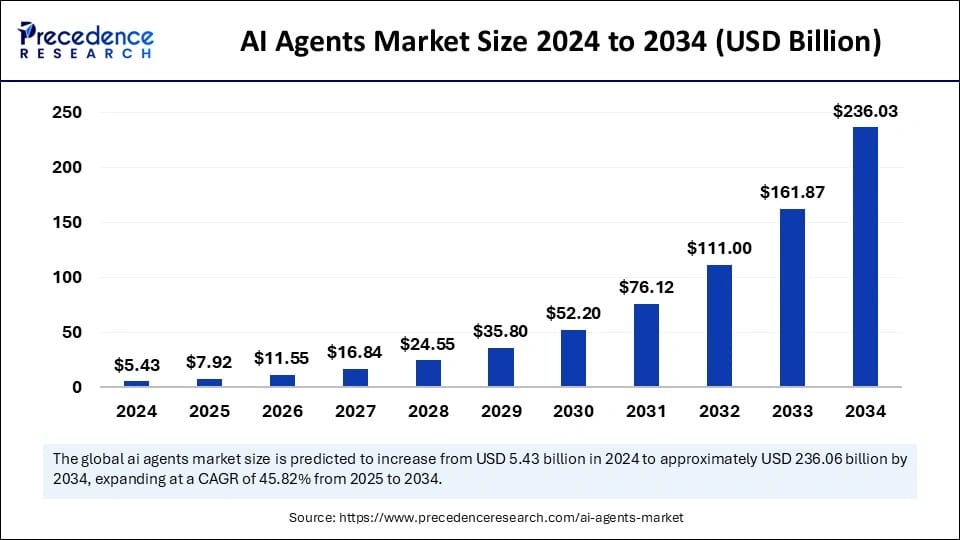
For context: that's faster than smartphones grew in their first decade.
What Actually Is an AI Agent? (And Why It's Not Just a Fancy Chatbot)
Here's the distinction most people miss:
Traditional AI: You ask a question. It answers. End of interaction.
AI Agents: They perceive their environment, reason about goals, make independent decisions, and take action to achieve those goals—all without constant human intervention.
Think about the difference this way:
A chatbot tells you the weather when you ask.
An AI agent checks the weather automatically, sees a storm warning, adjusts your calendar, suggests alternate routes, and notifies you—before you even think to ask.
One is reactive. One is proactive.
The core architecture of a real AI agent includes:
Natural Language Processing - Understanding human language and intent
Machine Learning - Learning from past interactions to improve decisions
Task Automation - Executing routine operations independently
Decision-Making - Analysing data and making informed choices
Tool Integration - Connecting with external systems, databases, APIs
Memory & Context - Maintaining conversation history and environmental awareness
That coffee shop demo I watched?
The agent remembered the customer's previous issues, connected to the shipping API, accessed the inventory database, pulled purchase history from the CRM, and made compensation decisions based on company policyall autonomously.
No human touched it. No one clicked "approve." It just... worked.
Why this matters: We're not talking about incrementally better customer service. We're talking about systems that can replace entire workflows.
General Electric saved $12 million annually using predictive maintenance agents. HappyRobot reduced shipping delays by 40% through AI agents that detect bottlenecks before they happen.
This isn't future tech. This is deployed, production, making-money-right-now technology.
The 6 Types of AI Agents (From Dumb to Scary Smart)
Not all AI agents are created equal. Understanding these six types is critical because each one solves different problems.
Type 1: Simple Reflex Agents (The If-This-Then-That Bots)
How they work: Basic if-then rules. No memory. No planning. Just pure reaction to the current situation.
Real example: Bank security alerts that trigger immediately when suspicious activity is detected. "If transaction > $5,000 AND location = foreign country AND time = 3am → Send alert."
Strengths: Fast. Resource-efficient. Reliable in stable environments.
Weaknesses: Can't adapt. No learning. Prone to errors if rules are incomplete.
When to use: Simple, predictable tasks where the environment doesn't change much.
Type 2: Model-Based Reflex Agents (The Simulators)
How they work: They maintain an internal model of how the world works and update it based on changes. They don't just react—they simulate outcomes before acting.
Real example: Amazon Bedrock uses internal models to predict outcomes, test scenarios, and optimize strategies without executing every action in the real world.
Strengths: Better decision accuracy. Can handle partial information. Adapts to environmental changes.
Weaknesses: Building accurate models is computationally expensive and requires frequent updates.
When to use: Dynamic environments where you need to predict "what happens if..."
Type 3: Goal-Based Agents (The Planners)
How they work: You give them an objective. They use planning and search algorithms to find the best path to achieve it.
Real example: Google Bard receives the goal "Write comprehensive product comparison for business decision-making" and automatically determines the steps: research competitors, analyze features, format data, fact-check claims, generate report.
Strengths: Flexible for complex tasks. Measurable performance. Works well in structured environments.
Weaknesses: Requires well-defined goals. Can't handle unlimited variables.
When to use: Complex tasks that can be broken into clear steps with a defined end state.
Type 4: Utility-Based Agents (The Optimizers)
How they work: When multiple goals exist or trade-offs must be made, these agents assign numerical values to different outcomes and choose the action that maximizes overall value.
Real example: A financial portfolio manager choosing between stocks, bonds, and crypto based on risk tolerance, time horizon, and expected returns. Or Claude AI optimizing credit card rewards by assigning utility values to spending categories and recommending the best card for each purchase.
Strengths: Handles uncertainty and multiple objectives. Balances competing priorities.
Weaknesses: Requires accurate utility functions. Computationally intensive.
When to use: Decisions involving trade-offs between multiple objectives (cost vs. speed vs. quality).
Type 5: Learning Agents (The Ones That Get Smarter)
How they work: They improve continuously through experience. They follow a cycle: Observe → Learn → Act → Receive Feedback → Adapt.
Real example: ChatGPT trained via Reinforcement Learning from Human Feedback (RLHF). It learned which answers humans find helpful and adjusted its behavior accordingly. AutoGPT conducts research, evaluates source reliability, and generates reports that improve with each iteration.
Strengths: Adaptable to changing environments. Improves over time. Handles complex scenarios.
Weaknesses: Requires large amounts of training data. Computationally expensive. Can develop biases from training data.
When to use: Environments that change frequently or tasks where "best practices" evolve over time.
Type 6: Hierarchical Agents (The Coordinated Teams)
How they work: Organised in layers, high-level agents set strategy while lower-level agents execute tasks. Perfect for complex systems requiring coordination.
Real example: Google's UniPi uses a high-level policy to generate instructions and a low-level policy to execute tasks. In a factory, upper-level agents plan production schedules while robotic agents on the floor execute specific movements.
Strengths: Efficient resource allocation. Clear communication structure. Reduces computational complexity.
Weaknesses: Fixed hierarchies limit adaptability. Can create bottlenecks.
When to use: Large-scale systems where coordination between multiple specialised agents is required.
How to Learn AI Agents Without Spending a Dollar
Here's the accelerated path from zero to building functional agents:
Week 1: Understand What Agents Actually Are
Microsoft AI Agents for Beginners (YouTube series)
10 video lessons, ~30 minutes each
No coding required for intro lessons
Covers fundamentals through advanced concepts
Total time: 3.5 hours
Week 2-3: Hands-On Building
DeepLearning.AI Short Courses (Pick 2)
LangChain for LLM Application Development - Building blocks for agents
Multi AI Agent Systems with crewAI - Build agents that collaborate
AI Agents in LangGraph - Advanced workflow orchestration
Interactive notebooks
1-2 hours each
100% free (optional paid certificates)
Week 4: Build Your First Agent (No Code Required)
n8n No-Code Agent Builder
Visual drag-and-drop interface
Pre-built AI agent nodes
Free self-hosted version
Automate something real in your workflow
No Python required. Just blocks and arrows.
Week 5+: Graduate to Production-Ready Agents
Pick ONE framework and go deep:
Option A - AutoGen (Microsoft)
Best for multi-agent systems
Open-source, completely free
Python-based
Excellent for enterprise applications
Option B - LangChain
Modular framework for LLM-based agents
Extensive documentation (doubles as a tutorial)
Python & JavaScript support
Industry standard
Option C - CrewAI
Specialised for agent collaboration
Low-code approach
Python-based
Great for role-based agent teams
Bonus Resources (All Free):
Simplilearn AI Agents Course - Free certificate included, covers agent types, ML, NLP, reinforcement learning
Hugging Face Deep RL Course - Train agents in simulated environments, 20-30 hours, self-paced
Coursera/edX (Audit for Free):
CS50's Introduction to AI with Python (Harvard)
Reinforcement Learning Specialisation (University of Alberta)
Generative AI with Large Language Models (AWS)
Just select "audit" instead of "enroll" and you get all lectures and readings free.
Prompt Tip of the Day
The Agent Goal-Setting Template That Actually Works:
Most people build agents with vague goals like "help with customer service." That's why their agents fail.
Use this structure instead:
AGENT ROLE:
You are a [specific role] responsible for [specific outcome].

PRIMARY GOAL:
[One clear, measurable objective]

SUCCESS CRITERIA:
- Metric 1: [specific number or state]
- Metric 2: [specific number or state]
- Metric 3: [specific number or state]

TOOLS AVAILABLE:
- Tool 1: [what it does]
- Tool 2: [what it does]

CONSTRAINTS:
- Do NOT [action] without [condition]
- ALWAYS [action] when [trigger]
- Maximum [resource] usage: [limit]

DECISION FRAMEWORK:
When [situation], prioritize [action A] over [action B] because [reason].
Why this works: Clear role. Measurable goals. Explicit tools. Hard constraints. Decision rules that prevent the agent from going rogue.
That coffee shop demo? The agent had crystal-clear success criteria: "Resolve customer issue with zero human input while maintaining customer satisfaction score above 4.5 and keeping compensation costs under $50."
No ambiguity. No guessing.
Reply