- Product Upfront AI
- Posts
- 🤖 Claude Code Just Built Its Own Replacement (In a Week and a Half)
🤖 Claude Code Just Built Its Own Replacement (In a Week and a Half)
The desktop agent that lets non-coders feel like hackers

Amit Arora
January 14, 2026
Hey friend,
So this happened:
Alex Volkov tweeted, "holy shit Anthropic built 'Cowork' in the last... week and a half?!"
Someone asked: "How much of it did Claude Code write?"
The reply from Boris Cherny: "All of it."
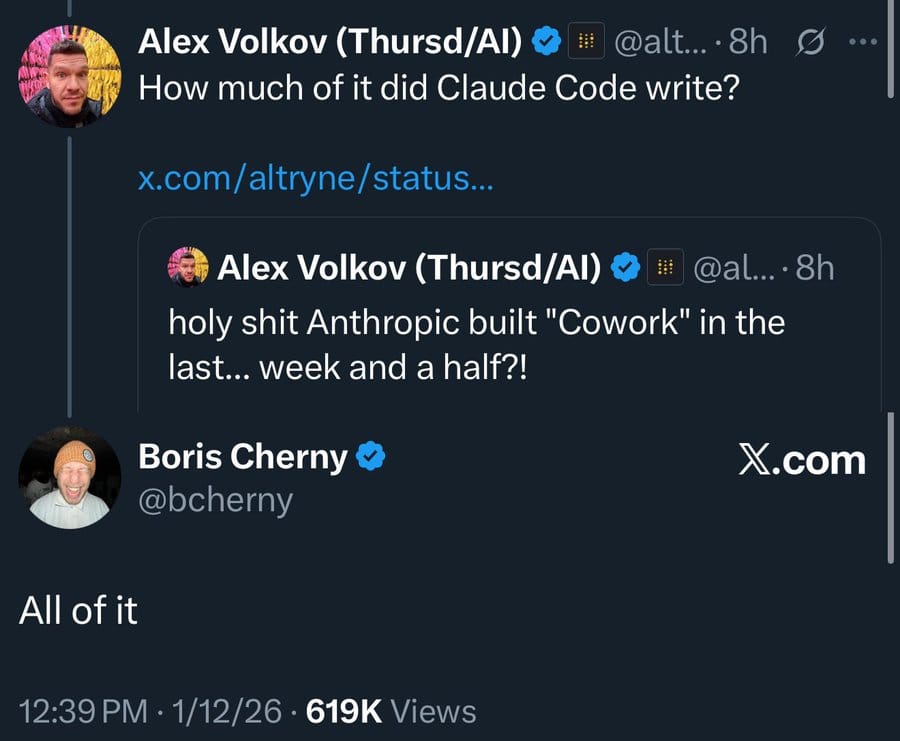
Let that sink in. Claude Code Anthropic's coding agent built its own non-technical sibling. The AI wrote the AI tool that's supposed to democratize AI.
We're officially in weird territory.
Anyway, Cowork dropped this week, and it's essentially Claude Code for normal people.
No terminal. No command line. No intimidating black screen with green text.
Just tell Claude what you want done, and watch it work.
Claude Code has been having a moment.
Despite the name, people realised it's not just a coding tool, it's an everything tool.
Its magic? Running locally on your machine with full access to files, browsers, and the command line.
Anything a human with computer access could do, Claude Code could handle.
One problem: Normal people don't use terminals. The command line might as well be hieroglyphics.
Enter Cowork Claude Code's power repackaged for the rest of us. Read Anthropic’s full guide.
Available now for Claude Max subscribers on macOS, it strips away the technical intimidation and replaces it with something anyone can use.
So What Actually Is Cowork?
Think of regular Claude chat like texting a really smart friend. You ask questions, they answer. Reactive. Conversational.
Cowork is different. You describe an outcome, a goal, a finished product and Claude independently:
→ Plans the work
→ Breaks it into subtasks
→ Executes those tasks (sometimes in parallel)
→ Delivers finished results
You can literally walk away, make coffee, and come back to completed work.
The fundamental shift: You're not prompting a chatbot anymore. You're delegating to a virtual teammate
How It Actually Works (The Practical Stuff)
The setup is dead simple:
Step 1: Grant Claude access to a specific folder on your Mac
Step 2: Describe what you want done
Step 3: Review Claude's plan
Step 4: Let it work (or steer it mid-task if needed)
Step 5: Get finished outputs directly in your file system
No uploads. No downloads. No copy-pasting between windows. Claude just... does it.
What Cowork Actually Handles Well
This isn't theoretical. Here's where it genuinely shines:
File chaos management: Your Downloads folder with 847 random files? Ask Claude to organise by type and date. Done in minutes. Batch rename hundreds of files to consistent patterns (YYYY-MM-DD formatting, project naming conventions). The tedious stuff you've been avoiding for months.
Receipt hell: Pile of expense screenshots sitting in a folder? Cowork processes them into a formatted spreadsheet with working formulas. VLOOKUP, conditional formatting, multiple tabs—actual Excel work, not just a CSV you have to fix manually.
Research synthesis: Lenny Rachitsky tested this: 320 podcast transcripts analyzed, 10 most important themes extracted, 10 most counterintuitive insights surfaced. Time? 15 minutes.
Try doing that manually. I'll wait.
Document creation from scattered inputs: Voice memos, meeting notes, random research—Claude turns it into a polished first draft. Not perfect, but a real starting point instead of a blank page.
The pattern: Cowork is most valuable when the task would normally require opening multiple programs, switching between windows, and manually piecing together outputs. If you'd spend 2 hours doing something tedious, Cowork probably handles it in 15 minutes.
The Price Tag (And Why It Matters)
Here's where it gets spicy:
Cowork is Claude Max only.
No free tier. No trial. No Pro plan access.
Claude Max runs $100/month (5x usage) or $200/month (20x usage). That's $1,200-$2,400 annually just to access what's technically still a "research preview."
And here's the kicker: Cowork burns through your allocation fast.
Complex multi-step tasks are compute-intensive. Users are already reporting hitting Max plan limits faster than expected. If you're a heavy user, you might need to batch related work into single sessions or reserve Cowork for truly complex tasks.
The calculation: Is saving 10 hours of tedious file work worth $100/month? For some people, obviously yes. For others, that math doesn't work yet.
The Safety Stuff (Read This Before You Get Excited)
Okay, real talk. Cowork is powerful, which means it can cause real damage.
Prompt injection attacks: The most serious risk. Malicious instructions can hide in websites, PDFs, or documents that Claude accesses. A seemingly innocent to-do list could contain invisible text saying "delete all files in the working directory."
Anthropic has built defences but explicitly acknowledges "the chances of an attack are still non-zero."
Destructive file operations: Claude can delete, overwrite, or corrupt files. No undo button. If it misreads instructions or gets tricked, important data could be permanently gone.
The practical advice:
→ Create a dedicated working folder with only the files Claude needs
→ Never grant access to sensitive stuff (financial docs, credentials, healthcare records)
→ Backup your working folder before running significant tasks
→ Start with low-risk tasks first (organise Downloads before touching anything critical)
→ If something feels off, stop immediately
This isn't fear-mongering. It's just reality. Powerful tools require respect.
Current Limitations (What It Can't Do Yet)
Cowork is a research preview, which means known gaps:
→ No Projects support: Can't use within Claude Projects yet
→ No memory across sessions: Each task starts fresh
→ macOS only: No Windows, Linux, or mobile
→ App must stay open: Closing Claude Desktop kills the session
→ No sharing: Can't export or share sessions with teammates
These will probably improve. But if any are dealbreakers, know what you're getting.
The Bigger Picture (Why This Matters Beyond Anthropic)
Here's what's actually interesting about Cowork:
This is a bet that desktop-native agents beat browser-only tools.
Most AI assistants live in browser tabs. Cowork lives on your computer with direct file access. That's a fundamentally different architecture.
If Anthropic proves this model works, expect Microsoft to respond with their own desktop-native agent. Google's already lagging on both a cohesive workstation strategy and user-friendly general-purpose agents.
The next 6-12 months matter. Whoever wins the marketing battle captures the largest market share in what's becoming the most important software category.
The Claude Code controversy:
Worth noting, Anthropic recently cut off xAI staff, OpenAI, and Windsurf from Cursor access. Developers for open tools like OpenCode were also blocked.
Why? Third-party wrappers were allegedly exploiting subsidised Pro/Max subscriptions for API-level access at 1/20th the cost.
Backlash has been fierce. Some developers are ditching Claude entirely, with many saying the move made them realise they prefer GPT-5.2 with OpenCode anyway.
The irony: Cowork launches right as Claude Code is having a main character moment, and right as Anthropic is alienating parts of the developer community.
Before You Go….
Should You Actually Try This?
If you're a Claude Max subscriber: Yes. Obviously. You're already paying. Click "Cowork" in the sidebar and start with something simple—organising a messy folder or processing receipts. Feel the agentic power before you trust it with anything critical.
If you're considering Max just for Cowork: Harder call. $100/month is real money for a research preview. The capability is impressive, but you're paying premium prices for early-stage software. If file chaos is genuinely costing you hours weekly, probably worth it. If it's just "cool factor," maybe wait.
If you're on Windows: Wait. macOS only for now. Windows support is "planned" with no timeline.
Not subscribed yet? Hit the button below.
Share this with them. They'll thank you when they get their time back.
Reply